Over the last few weeks I have written a lot about who can write to your AI and who runs it next month. Over the past days a piece of research answered a question most of us had quietly parked: what happens to a prompt after it leaves your network? The honest answer is that in many setups nobody can tell you, and some of the people who could tell you were attackers. At the same time the large model vendors are moving from "trust us" to "verify us". Both stories point to the same decision, and it is not a decision about which model is the smartest.
What did the canaries find?
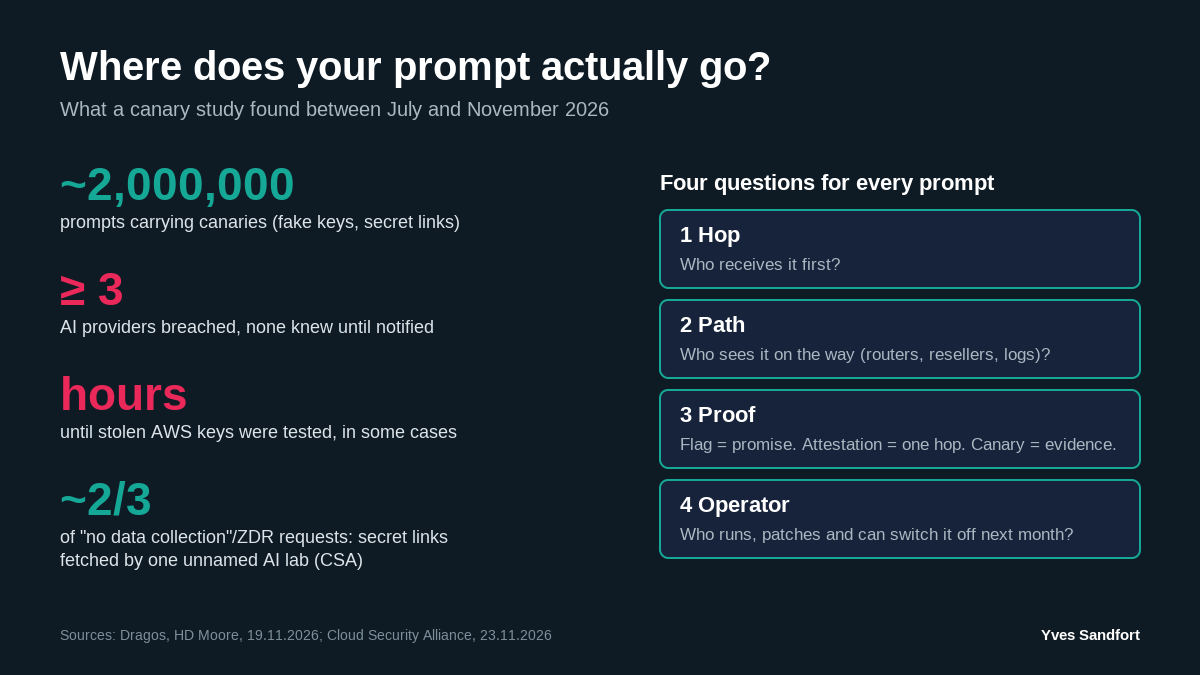
HD Moore and his team at Dragos did something very simple and very uncomfortable. Over a five-month period from July through November 2026 they sent nearly two million AI prompts through providers, routers and resellers, and they hid canaries in them: fake AWS keys, secret links, tokens that should never be touched by anyone. Then they waited to see who would touch them.
The results read like an incident report for an entire industry. According to Dragos, data from at least three AI providers was exposed, and none of the three knew until Dragos told them. The largest breach involved "a couple hundred of our AWS keys," and once attackers had keys, they tested them "in some cases within a few hours of our request," followed by tens of thousands of AWS API calls. Some of the stolen keys came from requests the provider had rejected before a model ever ran, which means the copying happened at the front door, not deep inside the model.
And then the line that should end a few procurement discussions: "In the other two breaches, some of the stolen requests were marked as ZDR." Zero data retention, the flag many of us put into contracts and architecture decks as the answer to the privacy question. Dragos puts it in one sentence: "A privacy flag doesn't help when the attacker is already inside."
It gets more interesting on the path. Dragos found that multiple resellers on an AI inference marketplace "were able to view and retain customer prompts using standard logging capabilities." No exploit needed. They "only had to list a model at the lowest price, enable request logging, and wait." One router was quietly forwarding some of its traffic to that marketplace, a hop the customer never saw. And according to Malwarebytes and the Cloud Security Alliance, an AI lab that Dragos does not name fetched the secret links from more than half of the prompts sent to its models, including about two thirds of the requests that were marked as no data collection or ZDR.
Isn't "verifiable" the answer?
Partly, and I want to be fair here. This week Sam Altman wrote that OpenAI is "now testing Private Inference" with "a small group of customers." On OpenAI's own page it is labeled "Private Inference (Alpha)" and described as combining "confidential computing with strict controls" designed to protect prompts and responses while the model processes them. Moving from contract language to technical controls is the right direction, and I would rather see vendors compete on what they can prove than on what they promise.
But look at what is still open. When OpenAI announced Private Intelligence in September, VentureBeat listed the unanswered questions, among them what customers can "independently attest or verify." There is no pricing, no GA date and no model list yet. That is normal for an alpha, it is not a criticism. It just means that today "verifiable" is a direction, not a control you can put into your risk register.
And even when it is there, an attestation proves which code is running on one specific hop, right now. It does not prove which router your request took to get there, who else logged it on the way, or who decides what runs on that hardware next month. A flag binds the provider who reads it. A proof covers the box it was issued for. Neither one covers the path, and neither one tells you who is in charge.
So is self-hosting automatically safe?
No, and I would be lying if I said it was. Last week Amazon's CISO CJ Moses described a campaign in which AI agents found a zero-day in an open-source AI tool on a university server, and took the server over. "In about 11 minutes, the agents went from mapping the application's API to arbitrarily writing files on the server," he wrote, according to The Register. The maintainers have published a fix, but the point stands: a self-hosted model or tool that is reachable from the internet and not on anybody's patch list is not private AI. It is private until the first scan.
Yes I know, that sounds like an argument against running AI yourself. It is not. It is an argument against running anything without an owner, which is a different thing and, honestly, a much older lesson.
Which four questions decide where a prompt goes?
When I look at the canary results, the vendor announcements and the self-hosting incidents together, I end up with four questions. Every prompt with sensitive content should have an answer to all four, and in most organizations I talk to, nobody has written down even the first one.
1. Hop: who receives it first? Is it the model provider you have a contract with, or a router, a gateway, a plugin, a reseller with the cheapest price this week? The first hop is the one your contract covers. Everything after that is somebody else's policy.
2. Path: who sees it on the way? Every proxy, router and marketplace in between can log. Dragos traced around two thousand routes, and several hundred of them ran through a system Dragos itself could not identify. If you cannot draw the path, you cannot claim a retention policy for it.
3. Proof: what can you verify, not just read? A ZDR flag is a promise. An attestation is a proof for one hop. A canary that fires is evidence. Dragos and the Cloud Security Alliance recommend seeding your own canaries and treating any use as an incident, and I think that is the cheapest control on this list. If you never test your privacy settings, you are trusting a checkbox.
4. Operator: who runs it next month? Who patches the inference stack, who decides which model version runs, who can switch it off at two in the morning? That question is the same whether the model runs in a vendor's data center or in your own, and it is the one that turns "self-hosted" from a risk into a control.
Notice what is not on the list: which model is the best. That matters for the result. It does not matter for where your data ends up.
So why would I run this on VCF?
Because for the prompts that really matter, the cleanest answer to "hop" and "path" is: the first hop is ours, and there is no path outside. And because a private platform only helps if question four has an answer, which is exactly where a single platform for compute, network, security and lifecycle beats a GPU box under somebody's desk.
Broadcom describes VCF 9.1 as a platform for production AI "operated under a single control plane, on infrastructure the enterprise owns and governs." With 9.1.1, Multi-Tenant Model Sharing was added, according to Broadcom with "tenant-isolated access controls" and "a single management plane for model access and policy," so that one centrally deployed model stack can serve several internal units instead of every department running its own copy. VCF 9.1.2, generally available since November 24, adds an AI infrastructure quickstart that, as Broadcom puts it, "automates Day 0 deployment through a single VMware vCenter plugin," and a GitOps service that lets you "govern access through existing identity with OIDC authentication." These are vendor statements, and I would read them that way. Some pieces, for example an AI gateway for prompt routing and usage controls, are still listed by Broadcom as future capabilities according to eWEEK.
What matters to me is not the feature list. It is that hop, path and operator become architecture decisions on a platform you already patch, segment and monitor, instead of settings in five different consoles. And the self-hosting lesson from above applies in full: the model endpoints belong in the same segmentation, the same patch process and the same inventory as every other workload. Private AI on VCF is not automatically safe. It is governable, and that is the difference.
How do we approach this at comdivision? With the same three steps we use for every VCF platform: Architect, Educate, Operate. For private AI that means deciding in the architecture which data classes may leave the building and which may not, designing the model platform, the network boundaries and the access model before the first GPU is racked, enabling the internal team to run model updates and lifecycle without depending on one person, and supporting operations afterwards. [ERGÄNZEN: konkretes Vorgehen von comdivision bei Private AI auf VCF, z. B. Datenklassifizierung, Modellplattform oder Betriebsunterstützung, nur belegte Angaben] We are highly specialized in the VMware ecosystem, especially VCF, and deliver clearly defined results at a fixed price rather than open-ended hours.
What should IT leadership ask this week?
- For our three most sensitive AI use cases, can someone draw the full path of a prompt today, including every router, gateway and reseller in between?
- Where do we rely on a zero data retention flag, and have we ever tested whether it holds, for example with our own canaries?
- Which of our AI services go to the model provider directly, and which go through a marketplace or a "cheapest available" route?
- Which self-hosted AI tools and model endpoints do we run, are they reachable from the internet, and who owns their patching?
- Which data classes are allowed to leave our infrastructure for AI processing at all, and who signed that decision?
Decide or go home...
Most of us did not decide where our prompts go. We picked a model, somebody picked an integration, and the path followed from whatever was cheapest or easiest that week. The canaries showed what that path looks like when someone actually checks.
A privacy flag is a promise. A proof covers one hop. Only an architecture covers the path. Decide which prompts may leave the building, decide who runs the ones that stay, and test both. #DecideOrGoHome
At comdivision we spend most of our time helping organizations design and run VMware Cloud Foundation, including the platform for private AI. If you want to talk about where your prompts should run and who should run them, reach out to me.
Sources
- HD Moore, "Three breaches, endless leaks: Your AI supply chain needs canaries", Dragos, 19.11.2026: dragos.com
- Danny Bradbury, "Researchers planted secrets in AI prompts. Attackers found them", Malwarebytes, 24.11.2026: malwarebytes.com
- Cloud Security Alliance AI Safety Initiative, "Canary Evidence of Prompt Theft at AI Inference Providers", 23.11.2026: labs.cloudsecurityalliance.org
- JP Caparas, "OpenAI is testing Private Inference, which keeps a prompt sealed while the model runs" (Altman post of 25.11.2026), Sulat, 26.11.2026: news.sulat.com
- OpenAI, "Private Intelligence", accessed 28.11.2026: openai.com
- Carl Franzen, "OpenAI's new 'Private Intelligence' targets a growing enterprise concern: who can see your AI data?", VentureBeat, 29.09.2026: venturebeat.com
- Jessica Lyons, "China attackers deployed AI agents that autonomously found and exploited a 0-day to take over a university server", The Register, 20.11.2026: theregister.com
- Sabina Anja, "VCF 9.1: The Secure, Cost-Effective Private Cloud Platform for Production AI", VMware Cloud Foundation Blog, 05.05.2026: blogs.vmware.com
- Rick Walsworth, "Announcing General Availability of VMware Cloud Foundation 9.1.1", VMware Cloud Foundation Blog, 03.09.2026: blogs.vmware.com
- Rick Walsworth, "Announcing General Availability of VMware Cloud Foundation 9.1.2", VMware Cloud Foundation Blog, 24.11.2026: blogs.vmware.com
- eWEEK Staff, "VMware Cloud Foundation 9.1.1 Adds Shared AI Models, but Key Features Remain in Preview", eWEEK, 03.09.2026: eweek.com